Associated Incidents
When Apple announced the iPhone X last month—its all-screen, home-button-less, unlock-with-a-look flagship—it placed an enormous bet on facial recognition as the future of authentication. For hackers around the world, Face ID practically painted a glowing target on the phone: How hard could it be, after all, to reproduce a person's face—which sits out in public for everyone to see—and use it to bypass the device's nearly unbreakable encryption without leaving a trace?
Pretty damn hard, it turns out. A month ago, almost immediately after Apple announced Face ID, WIRED began scheming to spoof Apple's facial recognition system. We'd eventually enlist an experienced biometric hacker, a Hollywood face-caster and makeup artist, and our lead gadget reviewer David Pierce to serve as our would-be victim. We ultimately spent thousands of dollars on every material we could imagine to replicate Pierce's face, down to every dimple and eyebrow hair.
For any reader with face-hacking ambitions, let us now save you some time and cash: We failed. Did we come close to cracking Face ID? We don't know. Face ID offers no hints or scores when it reads a face, only a silently unlocked padlock icon or a merciless buzz of rejection. All we learned from our rather expensive experiment is that Face ID is, at the very least, far from trivial to spoof.
Someone will no doubt successfully crack the system sooner or later—we haven't given up yet ourselves—just as hackers broke Apple's Touch ID fingerprint reader within days of the release of the iPhone 5. But Apple has successfully crafted an unlocking mechanism that's mostly effortless for a phone's owner and yet, for the moment, beyond our efforts to defeat it.
"Apple has really thought about the obvious attack scenarios," says Marc Rogers, a well-known hacker and researcher for the web security firm Cloudflare, whom WIRED enlisted to help with the Face ID cracking. Rogers gained distinction in the field as one of the first hackers to break Touch ID in 2013. "It's clear they tested against a range of materials, and built a model that’s robust enough to resist some pretty convincing attacks."
Not Just Another Pretty Face Recognition System
Apple's iPhone X keynote, earlier leaked materials, and patent filings Rogers dug up all indicated that the phone would do far more than just a two-dimensional face check. Simpler, flat-image scans had allowed earlier laptops and phones like the Samsung Galaxy S8 to be fooled by a mere photograph. Instead, the iPhone X projects a grid of 30,000 infrared dots onto a face, and then uses an infrared camera to read the distortion of that grid, creating a three-dimensional model.
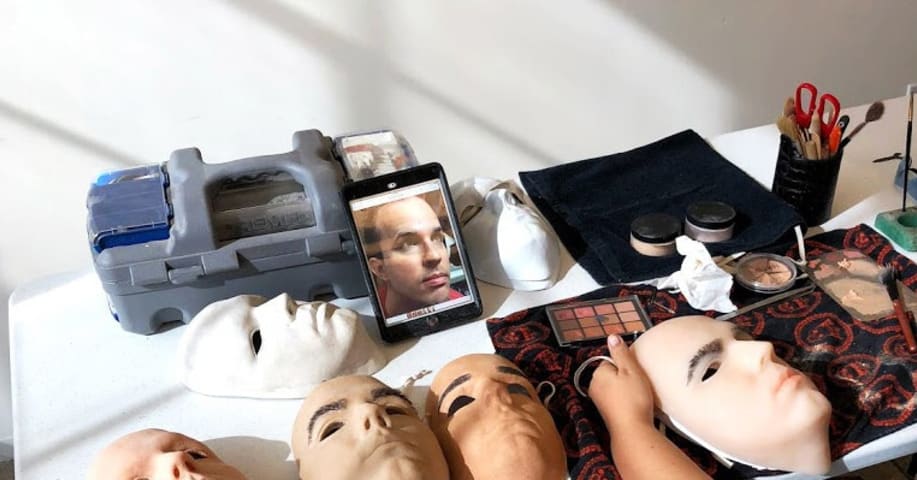
Makeup artist Margaret Caragan made masks duplicating WIRED writer David Pierce's face in silicone, gelatin, vinyl, plaster and plastic. David Pierce/Wired
And we knew that a model alone wouldn't cut it; Face ID uses "liveness detection" to ensure that the phone unlocks only when someone looks at it, not merely when the phone's sensors see its owner's face nearby.
Color, Rogers argued, likely wouldn't be a key element of Face ID's algorithm, since the technology would have to work in a variety of instances when someone's face color changes. Think different lighting scenarios, or a dark room, when you're sick or get a suntan. So we focused on proportions and texture as key to fooling Face ID's infrared eye.
In his keynote, Apple's Phil Schiller had boasted that the company had hired Hollywood artists to create masks to hone Face ID, showing a photo of incredibly life-like artificial faces on the screen behind him. But those faces had fixed eyes. And besides, Schiller had never actually stated that all of those masks had actually failed at spoofing Face ID, only that they'd been used to test it. (On Tuesday, the Wall Street Journal also published its own video showing an attempt to spoof Face ID with a silicone mask. But it appears that they tried only one material, didn't bother with eyebrows—a potentially key feature—and their mask didn't actually extend to the edges of the spoofer's face, leaving a visible border. We thought we could do better, thanks to some wildly misplaced hubris.)
Maria Lokke/WIRED
Sorry About Your Hair, David
In mid-October, we began the process of stealing the face of our would-be victim, WIRED senior writer and longtime iPhone reviewer David Pierce. Pierce sat in a chair in the Oakland studio of Margaret Caragan, the founder of Pandora FX, who has worked for more than a decade in making prosthetics and masks for TV and film. (She was also a contestant on season six of the SyFy makeup artist reality television competition Faceoff.)
Caragan put Pierce in a smock, and then smeared the front half of his head with lifecasting Smooth-on Silk-brand silicone, all the way up to the middle of his scalp. Smooth-on claims on its website that it detaches from short hair when it sets. Somehow Pierce was not so lucky, and in a freak mishap lost several hundred hairs. We'd