Associated Incidents
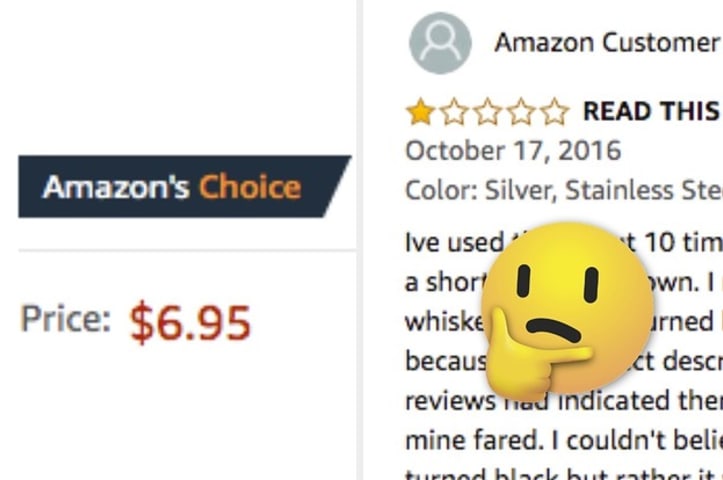
Amazon has said that it is “investing heavily” in ways to detect and prevent inauthentic reviews, as well as removing selling privileges from sellers that list different products on the same listing, which is against Amazon’s rules. Still, the review manipulation persists — and not only is Amazon unable to crack down on bad actors, but in some cases it’s also using a special badge to actively encourage customers to buy products whose sellers have recycled or purchased reviews. And although review recycling and inauthentic reviews don’t mean that a product is bad, they do make it harder for shoppers to distinguish legitimately good products from crappy ones.
Recommending products based on their star score comes with other complications, too. Reviews left on other products show that when customers are dissatisfied with products, sellers sometimes offer a replacement so that the customers will consider revising their review and raise their star rating, which distorts the ranking for faulty products.
Amazon customer R.D. left a one-star review of the faulty pet hair vacuum, but after she received a refund, the review was taken down without her consent. She contacted Amazon to report it, then attempted to republish the negative review. Amazon did not follow up, and her second review was never approved. “The vacuum still has great reviews and is listed as Amazon’s Choice. This whole incident deeply perturbed me,” she said.
The Amazon spokesperson declined to detail what happens when a listing marked “Amazon’s Choice” is found to have review manipulation specifically.
“This really does show that there could be a pattern of deceptive advertising at Amazon that the public needs to be aware of and be skeptical about. Amazon has tried to steer people, using its market power, into certain products in the past,” said Jamie Court, president of the Consumer Watchdog advocacy group.
Court pointed to a 2017 study in which Consumer Watchdog found that Amazon inflated list prices to make the site’s savings appear larger than they really were. The Federal Trade Commission began looking into the allegations over misleading reference prices in July 2017.
A spokesperson for the FTC, which regulates advertising, said that the agency doesn’t comment on business practices by specific companies. Regarding review recycling as a practice, however, FTC Public Affairs Officer Frank Dorman told BuzzFeed News in May 2018 that, “without commenting on any specific example, what we can say is that it’s deceptive to misrepresent that reviews for one product apply to a different product.” Dorman noted that fraud and deception are treated equally under the FTC Act.
No recommendation system is perfect, and when it works as intended, “Amazon’s Choice” does spare shoppers from having to sift through countless options in Amazon’s massive marketplace. The Amazon spokesperson said, “It’s been a really popular feature both on Amazon and on Alexa because it allows customers to make fast and easy decisions on what to buy.”
But the badge can be misleading, and it’s harder to hold an algorithm accountable for bad recommendations than a team of reviewers. “With everything I know about how sales rank can be abused and how many positive reviews that are fake can remain on the site, it’s tough for me to trust the [Amazon’s Choice] badge,” said Chris McCabe, who is a former Amazon marketplace investigator and now runs a seller consulting firm, eCommerceChris.
Perhaps it’s why, for some categories, Amazon has started including “Editorial Recommendations,” based on actual testing by sites like Wirecutter, OutdoorGearLab, and Reviewed, to compensate for “Amazon’s Choice” screwups.
While customers are nudged to buy shoddy products, highlighted by an algorithm that can’t detect nuances in review manipulation or customer sentiment in those reviews, Amazon still profits. McCabe said the Amazon’s Choice label encourages customers to buy, thus helping both marketplace sellers and Amazon (which earns a portion of each sale). “For sellers, Amazon’s Choice means they’re going to win the ‘buy’ box more. It ups their visibility. For customers, they’re going to buy more. It’s a trusted-brand seal of approval from Amazon itself,” McCabe said.
So when you’re shopping on Amazon and see something marked “Amazon’s Choice,” don’t immediately click to buy. First look at the reviews and see if there’s review recycling or anything suspicious about the quality of reviews. You can also copy the listing’s link and run it through a fake-review-detection system like ReviewMeta or Fakespot. Then do a quick Google search to see if the company selling the product has a legitimate website or if the item has been reviewed by a publication or site dedicated to consumer products, like Good Housekeeping, Consumer Reports, or Wirecutter. I know, it’s a lot of work. Whatever you do, don’t take “Amazon’s Choice” at face value.