Associated Incidents

Smoke billows from a building as Beyoncé, dressed in combat gear, climbs aboard an armored vehicle. Captain Ibrahim Traoré, the military leader of Burkina Faso, also appears in the video and fires a shot. “God protect Ibrahim Traoré in the battle for the people’s path, breaking the chains of the empire’s grip,” the song lyrics say.
However, it’s not actually Beyoncé or Ibrahim Traoré. The video is a “deepfake,” a type of content created using artificial intelligence to appear real.
Since late April, hundreds of AI-generated videos portraying Mr. Traoré as a pan-African hero, many containing misinformation, have flooded social media platforms across sub-Saharan Africa.
The trend has a wide reach, with social media users on X, Facebook, Instagram, TikTok, WhatsApp, and YouTube from countries like Nigeria, Ghana, and Kenya praising Mr. Traoré as an example for other African leaders. Some influencers describe themselves as "Pan-Africanists" and capitalize on disillusionment with local governments.
Nigeria and Kenya are among the top 10 countries publishing the most articles about Traoré on X.
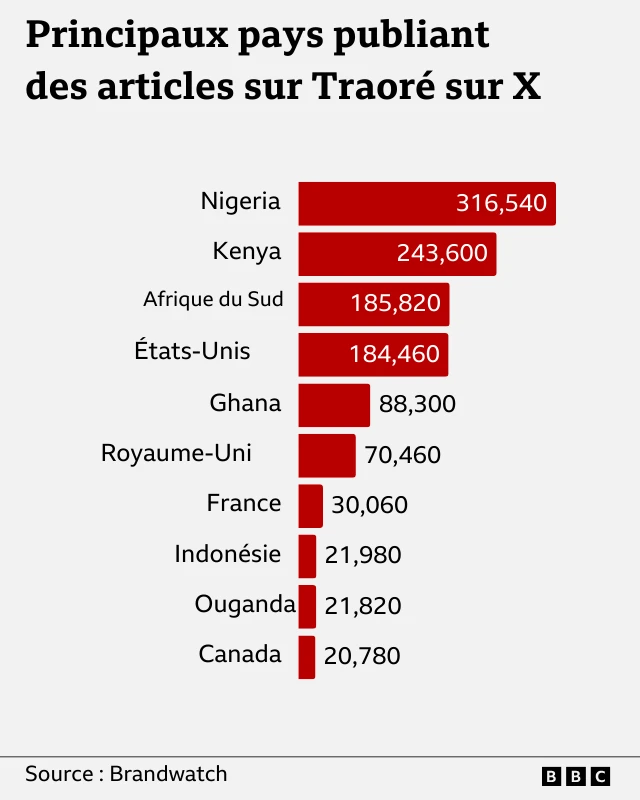
[Mentions of Traoré on X increased in May] 2025](https://ichef.bbci.co.uk/ace/ws/640/cpsprodpb/e2f0/live/ef504f60-3183-11f0-8947-7d6241f9fce9.png.webp)
Image caption: Mentions of Traoré on X increased in May 2025
Genuine or coordinated support
The 37-year-old head of the military junta, who seized power in this West African country in 2022, presents himself as a champion of anti-imperialism, criticizing what he sees as interference from Western powers, particularly France, while positioning Russia as a strategic ally.
Under Mr. Traoré’s presidency, Burkina Faso has experienced a democratic decline, with reports of journalists and opposition figures being detained and conscripted into the army. A recent Human Rights Watch report accuses government forces of killing at least 100 civilians in an attack in March.
But Mr. Traoré’s numerous public appearances and his image as a “down-to-earth” leader have helped build a powerful image that resonates both internationally and within Burkina Faso, drawing crowds of supporters to the streets of the capital, Ouagadougou. Some describe him as a “reincarnation” of Thomas Sankara, Burkina Faso’s iconic former military leader, who was assassinated in a 1987 coup.
According to observers, many young Africans are fed up with the status quo and their governments and are receptive to some of Mr. Traoré’s key messages, such as questioning ties with the West. He is known for his oratorical skills and media savvy, which also explains why some see him as a leader to emulate.
While Mr. Traoré enjoys tangible support across Africa, “the rise in AI-generated content used to fuel these narratives suggests it is not organic,” says Eliud Akwei, senior analyst at Code for Africa, a nonprofit organization that investigates disinformation on the continent.
Some AI-narrated videos masquerade as professional news reports, while containing misleading claims about Mr. Traoré or his government.
One video claiming that one of Mr. Traoré’s bodyguards “was offered $5 million to kill him” has been viewed more than a million times. Although Burkina Faso has reported attempted coups against Mr. Traoré since he came to power, there is no evidence that any have occurred.
One particularly popular video, with 4.5 million views, tells the story of a fictional incident on a plane where Mr. Traoré, not recognized by a flight attendant, is asked to give up his business class seat to a French businessman. Although the video was labeled a "work of fiction," numerous YouTube channels recounted the story as if it were a real incident.
Lassane Ouedraogo, an assistant professor of communication at Ohio University and a native of Burkina Faso, explains that "some messages on social media are wishful thinking. Others are based on real events, but presented with a great deal of exaggeration."
Meanwhile, fake music videos have emerged as a new tactic in the campaign, featuring celebrities such as Selena Gomez and Rihanna alongside Mr. Traoré. More than 40 of them were uploaded to YouTube within a week.
We spoke with the Nigerian creator of a deepfake video featuring Mr. Traoré alongside singer R. Kelly, which has been viewed 1.8 million times.
“The only reason I did this is the ‘Ibrahim Traoré effect,’” explains Oguji Nnamdi Kenneth, 33, who describes himself as a fan of the West African leader. He claims the video earned him $2,000 through YouTube monetization. “It’s purely artificial intelligence. I think people should know that. I’m not here to deceive anyone.”
Pro-Traoré accounts are sharing clips of an anti-government protest in Belgrade, while marches in support of Mr. Traoré are being organized.
Photo credit: X
Caption: Pro-Traoré accounts are sharing clips of an anti-government protest in Belgrade, while marches in support of Mr. Traoré are being organized.
Gold Reserves
Pan-Africanist social media accounts began boosting Mr. Traoré’s profile when he traveled to St. Petersburg for the Russia-Africa Summit in July 2023. Photos of him with Russian President Vladimir Putin and of his speech were widely circulated online, including by Russian state media, significantly enhancing Mr. Traoré’s image in the region.
A new wave of support and propaganda for Mr. Traoré then emerged. It began this year, in early April, following allegations raised in the United States.
During a hearing before the U.S. Senate, the head of Africom, General Michael Langley, accused President Traoré of using the country’s gold reserves to protect his regime. This triggered a wave of pan-Africanist messages on social media, claiming that the United States was seeking to remove him from power. Many of these messages contained misinformation.
On April 22, an account with nearly one million followers on X posted that Mr. Langley had told the US Senate that “the President of Burkina Faso, Ibrahim Traoré, is a threat to his people.”
However, according to the transcript of the hearing reviewed by the BBC, Mr. Langley stated that the proceeds from Burkina Faso’s gold reserves were “merely a bargaining chip to protect the junta.”
Data from Code for Africa shows that following Mr. Langley’s statement, a network of 165 Facebook accounts used an identical messaging app to amplify a false claim that Russian President Vladimir Putin had sent special forces to protect Mr. Traoré from the United States, generating over 10.9 million views in just 10 days.
In reality, Russian soldiers were already in Burkina Faso conducting counterterrorism operations, unrelated to the US remarks.
On X, another user posted a clip showing a large gathering of people. "Look at the crowds marching in France for Ibrahim Traoré and the sovereignty of Burkina Faso," they wrote.
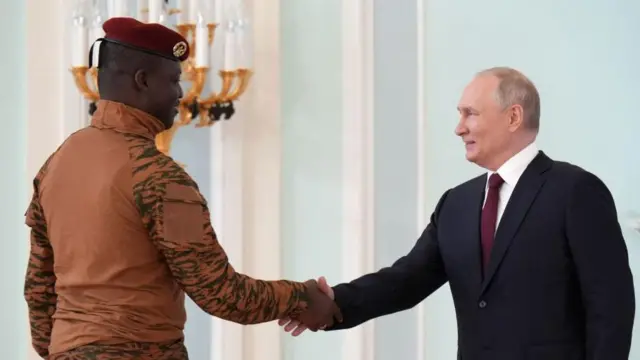
Photo credit: Getty Images
Image caption: Russian state media have notably boosted Mr. Traoré's image in Africa.
However, a reverse image search of a scene from the video shows that one of the buildings in the video is St. Mark's Orthodox Church in Belgrade, Serbia. The video shows an anti-government protest in Belgrade in March 2025.
The shared video garnered 3,000 likes and was not flagged as fake on the social media platform.
From his home in Ghana, blogger Sulemana Mohammed posted the same video on Facebook, claiming it showed a pro-Traoré protest in South Africa. Even after being informed by the BBC that it was not true, Mr. Mohammed stood by his claim.
"It's so funny when people pretend that what we say about our leaders isn't true," he said.
Describing himself as a Pan-Africanist, Mr. Mohammed said he admires Mr. Traoré because "he has become what the African people have been searching for all these years."