Associated Incidents
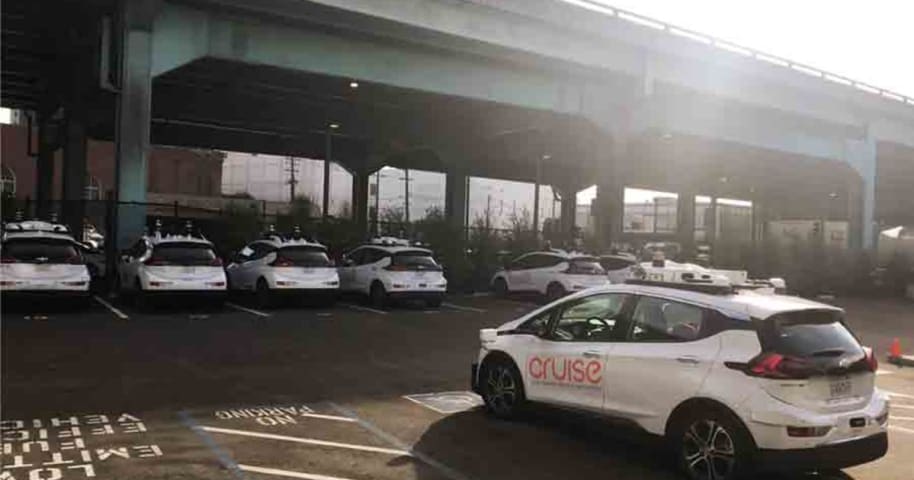
One day after California regulators awarded Cruise a milestone permit in its efforts to commercialize autonomous-driving technology, one of the company's vehicles was involved in a crash that resulted in multiple injuries.
The crash occurred in San Francisco on the night of June 3, when a Cruise vehicle operating in autonomous mode made a left turn in front of an oncoming Toyota Prius at the intersection of Geary Boulevard and Spruce Street.
Occupants of both vehicles were injured, according to a report Cruise filed with the California Department of Motor Vehicles. Todd Brugger, Cruise's vice president of global markets, wrote in the report that police and emergency medical services treated the occupants for "allegedly minor injuries."
General Motors-backed Cruise said its self-driving vehicle came to a stop in the roadway before completing its left turn, and was stationary when struck.
The company provided further statements about its interpretation of the position and behavior of the human-driven Toyota Prius in its filing, saying the Prius was speeding and that it had continued straight from a right-turn lane.
Those details could not be independently verified. A spokesperson for the San Francisco Police Department could not find an incident report related to the crash Wednesday, and said it was possible no report was generated.
The National Highway Traffic Safety Administration said it opened a special investigation into the crash.
NHTSA's special crash investigations are separate from defect investigations used to determine if vehicles should be recalled. The agency has not opened a defect probe into Cruise. NHTSA has opened 45 special crash investigations into crashes since 2016 involving suspected automated and advanced driver systems; this is the first involving a Cruise vehicle.
A Cruise spokesperson declined Wednesday to say why the AV stopped before completing its turn.
Although the Cruise vehicle may have been stationary, Phil Koopman, a Carnegie Mellon University professor and autonomous-vehicle safety expert, said much more information would still be needed to assess the behavior of both humans and machine in the crash.
"Many people have a word for a driver who cuts in front of them and then stops in the road, and it's not a polite or charitable word," he said. "There are a lot of unknowns here. We don't know if the Prius driver intended to turn right, but then swerved to try and avoid the crash with the stationary vehicle, for example. There are just a lot of unknowns."
In its mandatory report, Cruise said the crash took place while the vehicle was in "driverless autonomous mode." The company spokesperson declined to provide more specifics on whether the human occupant or human occupants in the self-driving car was or were a ride-hailing passenger or an employee.
'Exciting step' came one day earlier
Though the crash occurred more than a month ago, details surrounding it only emerged this week.
It happened one day after the California Public Utilities Commission granted Cruise a permit to collect fares from passenger service open to the general public with no human safety driver present in select San Francisco streets under certain conditions, the first such permit issued in the state.
"This is another exciting step for our autonomous vehicle program," CPUC president Alice Reynolds said in a written statement at the time.
That paid service had not yet started at the time of the June 3 crash, but Cruise had been providing free rides for select customers for months.
A spokesperson with the California DMV, which oversees the state's autonomous vehicle program, said the agency's officials have had conversations with Cruise executives since the incident. The CPUC did not return a request for comment Wednesday.
The crash raises questions, as Koopman noted, about the interplay between human and automated drivers and how they communicate their intentions to each other. Further, Cruise declined to say whether its vehicles have side airbags or side-curtain airbags, and if so, whether they deployed during the crash, in which the Prius struck the rear passenger side of the autonomous vehicle.
Latest in series of incidents
The June 3 crash is one in a series of incidents involving the company's vehicles in San Francisco.
On June 28, several Cruise vehicles clustered at a city intersection and blocked traffic for several hours. The incident was not resolved until human operators removed the vehicles. At the time, a Cruise spokesperson attributed the blockage to a "technical issue" but did not elaborate.
In April, one of the company's AVs blocked the path of a San Francisco Fire Department truck en route to a blaze, and city officials later told the CPUC the incident slowed the response to a fire that left injuries in its wake. Also in April, a San Francisco police officer pulled over a Cruise vehicle because it was operating without headlights on at night. The vehicle then repositioned itself before the traffic stop was complete.
Collectively, Koopman said the incidents painted a problematic portrait. "Everything is very concerning here," he said. "With this crash in particular, there are a number of very concerning things upon a plain reading of the crash report. The onus should be on Cruise to prove they're still safe to operate."