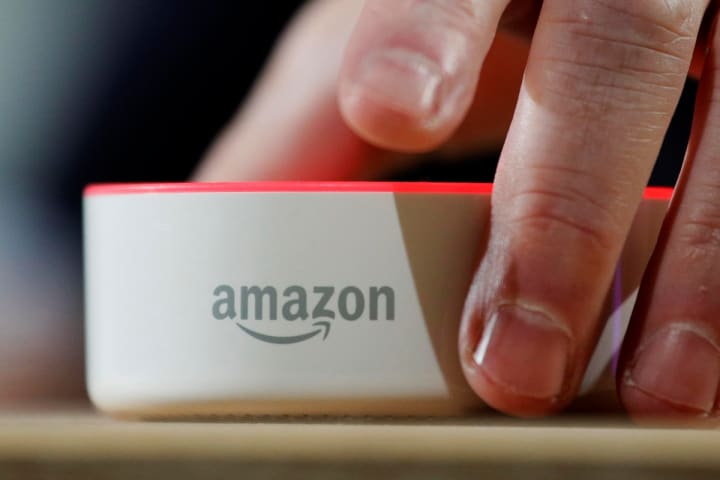
AMAZON has revealed how it stops your Amazon Echo speaker from waking up when the word "Alexa" is used in an official TV ad.
The company uses "acoustic fingerprints" that help your Echo understand that you're being advertised to, rather than asking her to get a job done.
AP:Associated Press 1 Not all "Alexas" are born equal – Amazon designs its Alexa ads to be ignored by your Echo speaker
Amazon's Alexa digital assistant is no small fry – the company is selling smart Echo speakers in huge numbers, and it's important to make sure the user experience is good.
The online retail giant was rightly concerned that any time it wanted to run a TV or radio ad demonstrating how the Echo speakers worked, the use of the word "Alexa" would "wake up" devices across the globe.
But this weekend, Amazon's 90-second Super Bowl commercial used the word "Alexa" just three seconds in, and the vast majority of Echo speakers will have ignored it completely.
"The trick is to suppress the unintentional waking of a device while not incorrectly rejecting the millions of people engaging with Alexa every day," said Amazon's Shiv Vitaladevuni.
What is Alexa? If you've never heard of Alexa, here's what you need to know... Alexa is an "intelligent" personal assistant built by Amazon
You can find her on several different devices, including Amazon's Echo speakers
Alexa responds to voice commands, and can talk back to you
She can perform thousands of different tasks, including telling you about the news or weather
But she can do more complex things too, like ordering a pizza or arranging an Uber taxi pick-up
To activate Alexa, you need to say "Alexa" to an Amazon Echo speaker
Alexa currently only works in English and German languages
Because she's powered by artificial intelligence, Alexa is constantly getting smarter
Alexa will also get more used to your voice, and better understand what you want her to do over time
According to Amazon, it's all thanks to a digital signature: "Acoustic fingerprinting technology can distinguish between the ad and actual customer utterances."
The company can obviously anticipate major ad events like the Super Bowl, and modify the sound files to prevent a false wake-up.
But Amazon can also react "on-the-fly" to events where the word "Alexa" is broadcast unexpectedly – like a TV sketch.
"When multiple devices start waking up simultaneously from a broadcast event, similar audio is streaming to Alexa's cloud services.
"An algorithm within Amazon's cloud detects matching audio from distinct devices, and prevents additional devices from responding."
10 things you should get your Amazon Echo to do when you first set it up
Amazon says this system "isn't perfect", but that between 80% and 90% of devices won't respond to broadcast's thanks to the "dynamic creation of the fingerprints".
But what does this "digital fingerprint" actually mean?
Around a year ago, a Reddit user called Asphyhackr investigated Amazon's Alexa software, and discovered that Alexa ads were transmitting weaker levels of sound between the frequencies of 3,000Hz and 6,000Hz.
These frequencies aren't outside the range of human hearing, but we're not very sensitive to that sort of sound.
MOST READ IN TECH Revealed ROBO-STOP Police could soon 'hijack' your car and limit your speed remotely from ANYWHERE SPY IN THE HOUSE Amazon listening to YOU as staff record Alexa clips including sex assault Exclusive WE'VE P-P-P-PICKED IT UP Sun reader spots a penguin on MARS and sparks awkward questions Revealed GAME OVER PlayStation 5 and Xbox 2 could be ‘last games consoles’ you EVER own CORE OF THE PROBLEM? Apple engineer says pressure to design iPhone is reason I’m divorced Revealed HANDSET HACK Genius iPhone trick lets you find ANY photo from your camera roll in seconds
So he theorised that Amazon might be scrubbing that frequency range in Alexa ads, in order to tell Amazon Echo devices not to wake up.
He then recorded someone saying "Alexa" and deleted that frequency band, and his own Echo speaker ignored the command – seemingly proving the theory correct.
Amazon hasn't confirmed that this is exactly how the digital fingerprint works, but it seems as likely a theory as any.