JAKARTA, Indonesia – A malfunctioning sensor and an automated response from the aircraft’s software stymied pilots’ efforts to control a doomed Indonesian flight that went careening into the sea last month, according to a preliminary investigative report released Wednesday.
The report, which stops short of determining the cause of the crash or analyzing findings, chronicles the chaotic moments on the Lion Air flight before it crashed into the waters off the coast of Java last month, killing all 189 passengers and crew on board.
It details how sensors and other equipment were checked and fixed before the aircraft’s final flight, but not the “angle of attack” sensor. That measures where the nose is pointing and was showing erroneous readings throughout the short time the plane was airborne.
With the sensor insisting the nose was too high, an automatic feature kicked in, sending the plane plummeting as the pilots wrestled to regain control. Unable to trust their readings, the pilots resorted to asking air traffic control about their speed and altitude.
Lion Air Flight 610 plunged into the Java Sea on Oct. 29 just after taking off from the Indonesian capital, Jakarta, killing the eight crew members and 181 passengers on board, including a child and two infants.
The crash appears to have been caused by a mix of brand new technology and cockpit confusion as the pilots fought to gain altitude after an early-morning takeoff from Jakarta. The flight crew – at an altitude of just 5,000 feet – had very little time to resolve the issue before the plane crashed into the sea at a reported 450 miles per hour.
Though the report contains no conclusion assigning blame, its descriptions of automated systems overtaking the aircraft – leaving pilots both confused and powerless – poses questions for Boeing and Lion Air about whether the cockpit crew was prepared for this scenario. After the Lion Air crash, pilots in the United States accused Boeing of withholding safety information on its new 737 model.
The aircraft’s pilots asked to return to Jakarta just two minutes after takeoff, reporting a “flight-control problem” but not specifying what it was.
Black-box data released by Indonesian investigators showed that the pilots were pulling back on the control column, attempting to raise the plane’s nose, with almost 100 pounds of pressure before they crashed.
The Indonesian National Transportation Safety Committee, which produced the report, also said that Lion Air, a Jakarta-based low-cost airline, should improve its “safety culture.”
No engineer briefed the pilots of the crashed plane on the multiple problems the aircraft experienced on previous flights, and it was up to him to review the maintenance logs.
The report, however, contains no conclusion on who was at fault.
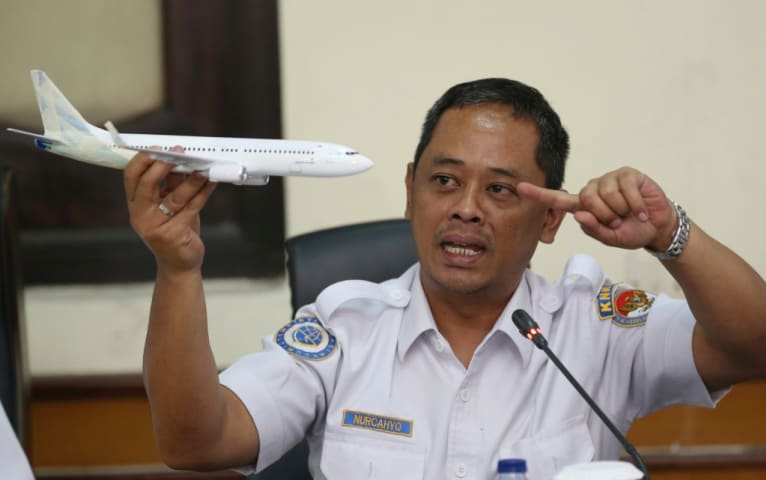
“When it comes to faulting, I don’t know. Our job isn’t to find faults,” National Transportation Safety Committee investigator Nurcahyo Utomo said at a news conference Wednesday.
The aircraft was the most recent incarnation of the venerable Boeing 737, a plane that first flew in 1967 and has gone through multiple iterations before it emerged as the 737 Max.
The 737 Max was equipped with more-powerful engines that are mounted farther forward on the wing, requiring that additional software be added to the autopilot to provide more control.
That software, which has been described as several lines of coding, was identified in the Boeing manual as the maneuvering characteristics augmentation system, or MCAS.
When the sensors transmitted faulty data to the cockpit of Flight 610, the new MCAS system sensed a stall – that point at which planes do not have enough airspeed to create lift – and sought to correct for it by repeatedly pointing the nose of the aircraft down.
A feature in previous 737 models that allowed pilots to manually override an “electric trimming” process – which automatically budges the nose downward to prevent a stall, does not work in Boeing’s 737 Max 8 planes, Boeing explained in a Nov. 7 bulletin.
That same week, the Federal Aviation Administration issued an emergency notice to all airlines that fly the 737 Max, warning them that erroneous sensor inputs “could cause the flight crew to have difficulty controlling the airplane,” leading to “possible impact with terrain.”
The deviation probably was caused by what is called a “runaway stabilizer.” Stabilizers are essentially those small wings on either side at the tail end of the plane. They each have flaps – called elevators – that help control the elevation of the plane.
In case of a runaway stabilizer, pilots are instructed in the cockpit checklist to hold the control column firmly, disengaging the autopilot that, in this case, contained the MCAS program. Next, they are told, disengage the auto throttle and manually fly the plane.
“This corner of the performance charts is called the ‘coffin corner,’ ” said Mary Schiavo, an aviati