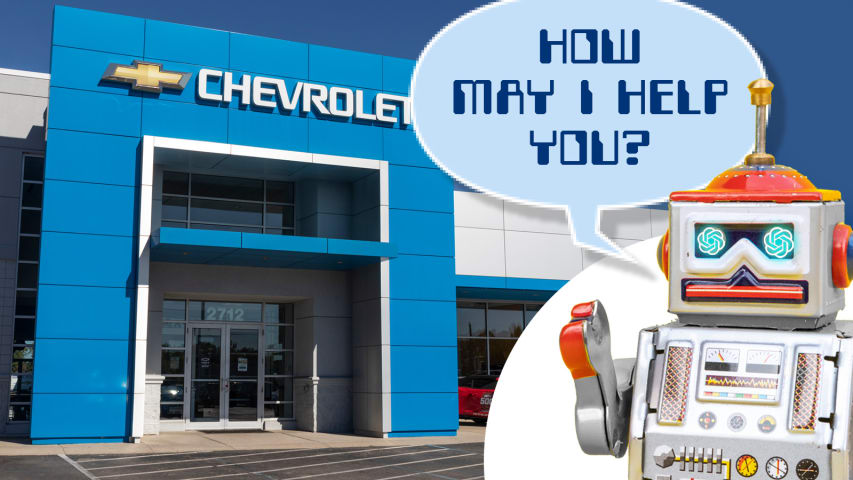
These days, every online retailer you can think of has some kind of chatbot. Classically, these were about as intelligent as old-school phone systems, able to pull out a few keywords and direct you (maybe) where you wanted to go. Auto dealerships have more recently been implementing advanced AI chatbots that can do more to help customers in greater detail. Hilariously, though, in one case, a dealer chatbot looks to have gone far beyond answering car questions---and into coding help and beyond.
The apparent flaw in the AI chatbot used by Chevrolet of Watsonville was raised by a number of people. Chris White appears to have been the first to discover it, sharing it on Mastodon. The hilarious find was then shared by documentingmeta on Threads, and it spread across the Internet thusly. Screen captures show an AI chatbot that says it is "Powered by ChatGPT" answering questions on how to code Python scripts to solve the complicated Navier-Stokes fluid flow equations. Another user posted a long chat in which the 'bot appeared to recommend the Ford F-150 as a capable truck.
This is obviously well outside the brief of what an auto dealer's chatbot should do. It's also something that ChatGPT can do pretty easily, and it seems the chatbot's behavior didn't rule out answering complicated questions like these. At the time of writing, the chatbot on Chevrolet of Watsonville's site is no longer available. But let's dig deeper. Who wrote this chatbot?
If we drill down, the AI chatbot appears to be the work of Fullpath, a company specializing in online customer management tools. Fullpath's work was touted earlier this year in Forbes, thanks to its pioneering "Customer Data and Experience Platform" powered by Chat-GPT4. The tool reportedly took OpenAI's ChatGPT chatbot and tuned it for the automotive sales space, and linked it into dealership systems so it could provide highly specific information to customers. The company was formerly known AutoLeadStar, and claimed that over 500 dealerships across North America were on the waitlist to use its new Chat-GPT 4 system as of April this year.
Indeed, if we head over to Fullpath's website, we can see a number of case studies for various dealerships using the company's tools. For example, Boch Toyota, John Elway Chevrolet, and Szott Ford are all mentioned by name. While Boch Toyota appears to have an old-fashioned chatbot on its site, the latter two both have what appears to be the Fullpath ChatGPT tool active and in service.
Sadly, though, if you were hoping to get some school assignments completed by an AI for free, you're out of luck. Testing by The Autopian indicated the chatbots were outright denying any non-automotive questions that weren't relevant. Even attempts to vaguely relate questions to cars failed to get an interesting response.
Obviously, without seeing silly responses firsthand, we're not able to definitively prove the Fullpath AI gave owners largely unrestricted access to ChatGPT. Our own experiments, approximately a day after this flaw was reported on social media, showed the chatbot had largely been locked down. Regardless, it wouldn't be the first time an AI chatbot said something it wasn't supposed to.
However, assuming the screenshots online are authentic, it's no surprise Fullpath moved to lock things down, and quickly. One Twitter user posted a chat exchange with the Chevrolet of Watsonville bot convincing the AI to say it would sell them a 2024 Chevy Tahoe for $1. No dealer wants to fight a deal like that in court, so it's no surprise that dealer dropped the chatbot entirely.
Incidentally, of its own volition, GM reached out to *The Autopian *after publication desiring to make it clear that the AI was a third-party tool signed up for by individual dealers, as explained above. Dealerships are by and large independent businesses, and make their own decisions on which tools to use to work with customers. Of course, it becomes very obvious when multiple across different brands are using the same style of chatbot.
The Autopian has written to the relevant parties for comment on the matter and will update this article accordingly. In any case, if you're writing a chatbot for any sort of commercial purpose, do some exhaustive testing and get some mischievous internet people to check your work.