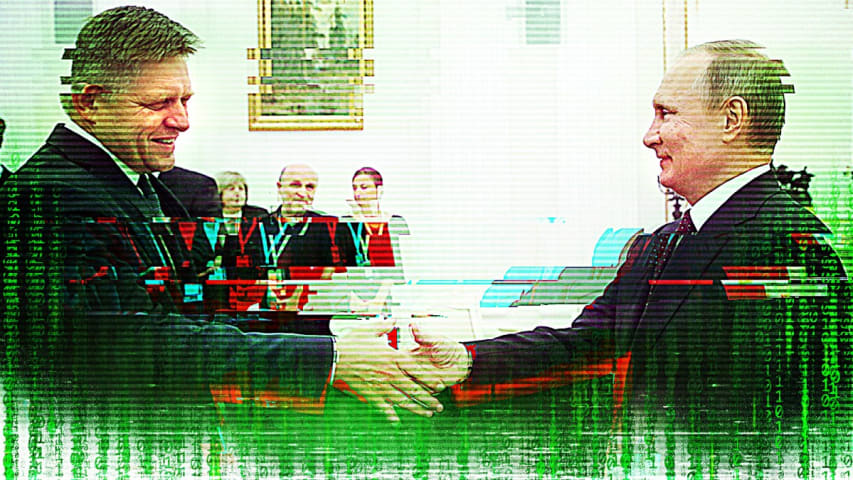
A couple of days before Slovakia's election last Saturday, a prominent journalist was sent a recording circulating on social media that alarmed her. In it, Monika Todova heard herself discussing with Michal Simecka, a leading liberal politician, ways he might rig the vote.
Their two-minute "conversation" --- which may have been heard by hundreds of thousands of people --- never took place, however. It was a deepfake, made using artificial intelligence.
The same was true of another recording that had surfaced a few days earlier in which the 39-year-old politician was heard talking about a secret plan to double the price of beer to curb alcoholism if his party came to power.
It is still not clear how much the bogus clips influenced the result of the election, which was won by Simecka's arch-rival, Robert Fico, 59, a pro-Russian populist, whose Smer-SD party urged an end to military support for Ukraine, vowing not to send "a single round" more.
A former prime minister, Fico was forced from office in 2018 after tens of thousands of people protested against the fatal shooting of a journalist investigating links between top politicians and the 'Ndrangheta, a branch of the Italian mafia.
The recordings have implications that go far beyond this central European country of 5.5 million people whose loyalties seem increasingly split between East and West. The deepfake genie is out of the bottle. "I was disgusted," Todova told me last week in the office of Dennik N, the newspaper for which she works, on the outskirts of the capital, Bratislava.
Given her frequent public appearances, there was plenty of audio of her around for the fakers to draw on. "It's my words, but not my sentences," she said of the recording, which she quickly had taken down. "My friends and our readers realise it's a deepfake, but people who voted for Smer-SD or Republic [a far-right party] think it's real."
Todova, 41, made her name with investigations into corruption that have turned her into a hate figure for Smer-SD. She wants police to investigate, but doubts they have the means --- or the will --- to trace the clip back to its source. She would also like them to take action against a former right-wing MP who forwarded it to his followers.
"Hundreds of thousands heard [the clip] and it became a major talking point among the public before the election," said Tomas Krissak, an expert on information security at Gerulata Technologies, a Slovak company that uses AI to track disinformation. Although Krissak has not been able to establish its source, he found it spread particularly in channels on the Telegram app usually filled with content supporting Fico's party.
Deepfakes have long been the stuff of fiction: the technique is at the heart of The Capture, the mystery thriller series that premiered on the BBC four years ago. Reality has since caught up. In Britain, for example, recent months have seen an increasing number of online financial scams involving fake endorsements purporting to come from well-known names. The late comedian Robin Williams's daughter, Zelda, complained on Instagram last week about the use of AI to recreate his image, calling it a "horrendous Frankenstein monster".
The technique is finding its way into politics, too. In war-torn Sudan, a campaign using artificial intelligence to impersonate Omar al-Bashir, the former leader, has been viewed by hundreds of thousands on TikTok. Experts on online disinformation are also keeping a close eye on Poland, which chooses a new parliament next Sunday. There are deep concerns about the role that deepfakes may play in elections next year in the US, UK, India and the European Union.
Hany Farid, a digital forensics expert at University of California, Berkeley, has warned that deepfakes pose a two-fold threat to the democratic process. "One is the ability to create an audio recording of your opponent saying things that they never said," Farid said in an interview with America's National Public Radio. "But the other concern we should have is that when the candidate really does get caught saying something, how are we going to determine whether it's real or not?"
Such techniques have obvious appeal for the Kremlin, which during the 2010s pioneered "troll farms", whose targets included the 2016 US election that brought Donald Trump to power. Russia also strives to influence public opinion in central and eastern Europe, whose strategic importance has grown since the start of the war in Ukraine in February last year.
Slovakia is fertile ground for Kremlin propaganda. Its people have been among the most pro-Russian in the region since the growth of Slavic nationalism in the 19th century when Slovaks looked to their big Slavic brother in the east to liberate them from the Austro-Hungarian Empire. Such traditional enthusiasm was temporarily dented by Putin's invasion, but as the war has continued, "Ukraine fatigue" appears to be setting in.
The three short-lived pro-western governments that have run Slovakia since Smer-SD's defeat in the last election in 2020 "recognised that we are very vulnerable, particularly because of the attitude of people towards Russia", said Pavol Demes, a former foreign minister turned political analyst. One of the results was the expulsion in March last year of 35 Russian diplomats, amid allegations of espionage. Researchers at Demagog SK, a fact- checking organisation, noted a rise in disinformation in the run-up to the election, which turned into a duel between Simecka's Progressive Slovakia party, which wants to maintain the country's pro-western, pro-EU stance and Fico's Smer-SD, which is Eurosceptic and wants warmer relations with Moscow.
The two clips appear to have been the first true deepfakes in Slovakian politics, according to Veronika Hincova Frankovska, its project leader. "This is something really new for us," she said.
Whether such material originates in Slovakia or abroad --- such as in Russia --- is not clear, though hours after the second recording appeared, Sergey Naryshkin, head of Russia's foreign intelligence service, muddied the water with a statement accusing Washington of trying to subvert the election and Simecka of advocating American interests.
Monika Todova is a prominent journalist, so there were plenty of recordings of her speaking available for fakers to manipulate
But did the two deepfakes work? And do they explain how Smer-SD, though several points behind its main rival in exit polls, beat it by 23-18 per cent once the votes had been counted.
Tomas Valasek, vice-president of Progressive Slovakia, is not convinced: his party's own analysis suggested it was better at winning over undecided voters in the last days of the campaign. "If Smer or whoever put it out was hoping to discourage people from voting for us and perhaps to vote for them instead, it just hasn't had that effect," he told me.
If the polls underestimated support for Fico's party, then it was because many of his voters were convinced the election would be rigged and, believing the pollsters were part of the conspiracy, refused to talk to them, Valasek said.
Yet even if the clips did not change minds, Hincova Frankovska believes they may have mobilised Progressive Slovakia's opponents to turn out and vote. "Disinformation normally begins by targeting people within the bubble and then slowly spreads," she said.
The prospect of Fico, an ally of Viktor Orban, the "illiberal" Hungarian leader, as prime minister for a third time has caused disquiet in Brussels, which fears he would join an eastern "awkward squad" that also includes Poland's ruling Law and Justice Party, which hopes to be confirmed in power next week.
This is not assured, thanks to the fragmented nature of Slovakian politics, with seven parties in parliament. "Fico won the election, but may lose the coalition talks," said Milan Nic of the German Council on Foreign Relations. Fico's former deputy, Peter Pellegrini, whose Voice --- Social Democracy party came third with almost 15 per cent, has emerged as a kingmaker. The two men are thought to loathe each other.
Such is Slovakia's dependence on Europe, though, that even if Fico becomes prime minister, "we shouldn't panic that it is going to be a second Hungary", said Demes. "I am sure Slovakia will remain a pro-Nato and pro-European country."
It could nevertheless be weeks before Slovakia gets a new government. In the meantime, it will be impossible to force the deepfake genie back into the bottle.