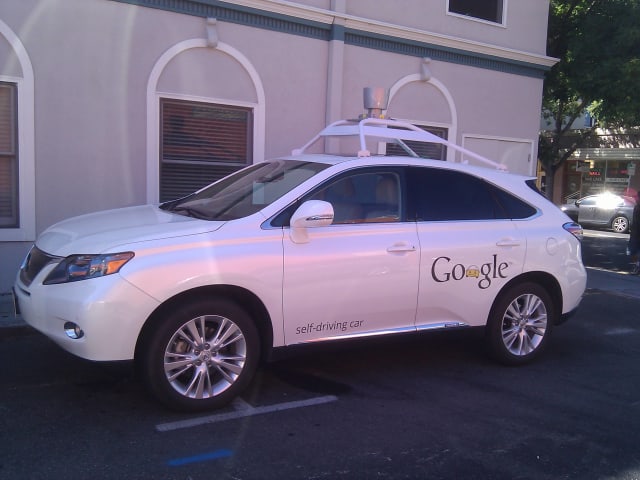
One of the main reasons behind Google’s commitment to driverless cars is their ability to avoid accidents and improve traffic safety , as they eliminate human error, which is the single most common cause of motor vehicle crashes. Up until a few weeks ago, the tech giant’s self-driving car prototypes had covered a total of 1.8 million miles without causing any accident, but their crash-free record was on a brink of being tarnished recently, with a report claiming that one of the cars almost hit another vehicle while being operated on a public road in California.
As reported by Reuters, one of Google’s driverless cars nearly collided with another car while driving in Silicon Valley, but an accident was avoided thanks to a timely maneuver performed by the tech company’s car. The fact that the other vehicle involved in this close encounter was also a self-driving car, makes the situation that much more intriguing. The other vehicle in question was an Audi Q5 crossover fitted with self-driving equipment developed by Delphi Automotive. Delphi’s vehicle was driving along a street in Palo Alto, when it started performing a maneuver to change lanes, but was cut off by Google’s car – a Lexus RX400h, and was forced to return to its lane and try to perform the lane change later.
Even though an accident was avoided, this close call got a lot of media attention, as it reveals that there is still a certain risk of autonomous vehicles getting involved in potentially dangerous traffic scenarios. On the other hand, it also shows that driverless cars are capable of detecting traffic situations that could jeopardize the safety of their occupants and other road users, and taking appropriate action to avoid them.
Delphi was quick to deny the reports of a near collision and explain that the reported incident actually reaffirms the ability of self-driving cars to avoid accidents. John Absmeier, director of Delphi’s Silicon Valley lab, was a passenger in the Audi Q5 when the incident took place, and later said that it wasn’t nearly as serious as media tried to portray it.
“The story was taken completely out of context when describing a type of complex driving scenario that can occur in the real world. Our expert provided an example of a lane change scenario that our car recently experienced which, coincidentally, was with one of the Google cars also on the road at that time. It wasn’t a ‘near miss’ as described in the Reuters story,” said Delphi in a statement.
In any case, no matter how harmless this incident was, it is bound to raise more concerns over whether autonomous cars are really able to operate on public roads without causing any accidents and without being a threat to public safety, and it might well have a negative impact on the public perception of self-driving cars.