27 Maximum speed, in mph
12 Number of passengers it can hold
When is it on the road? The vehicle drives along east Fremont Street between Las Vegas Boulevard and Eighth Street with regular street traffic from 10 a.m. to 6 p.m.
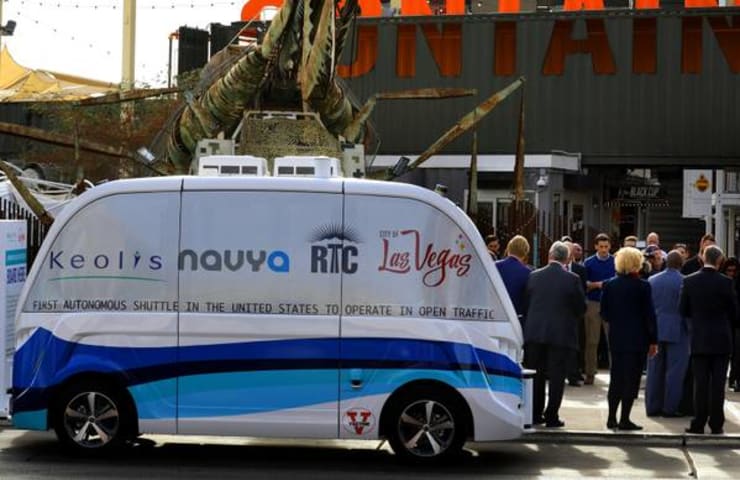
The Innovation District in Downtown Las Vegas is pushing the boundaries on smart city technology, and one of its more popular tests to date is the self-driving shuttle.
Transporting riders around a 0.6-mile fixed route, the shuttle, a partnership with Navya, Keolis and AAA, has transported more than 10,000 passengers since launching in November. Its goal is to transport 100,000 passengers before the yearlong project commences.
When people see the shuttle cruising about downtown, they may not be aware of all the technology taking place for the autonomous vehicle to operate properly and safely.
How does the shuttle know where to go and what’s in its way?
The shuttle utilizes multisensor technology that includes various sensors and cameras to help the vehicle understand and visualize its surroundings. The sensors share information with the computer, which makes decisions and acts upon them. Autonomous vehicle testing won’t stop with the shuttle in the Innovation District, as an autonomous taxi, Robotaxi, took a test run during CES. Joanna Wadsworth, a city of Las Vegas traffic engineer, said there are tentative plans for a long-term pilot program this year.
Is it safe?
After the deadly crash involving a self-driving Uber vehicle and a pedestrian in Arizona, the City of Las Vegas has no plans to take its driverless shuttle program off the road.
“Our focus is always on providing safe, reliable and efficient transportation services to the residents and visitors of our city,” city spokesman Jace Radke said. “We are aware of the tragic accident in Arizona and will review the findings from that investigation when complete.”
Uber had been testing the self-driving vehicles in Tempe and Phoenix for months. Those tests have been suspended after the crash.
The city noted that the environment and the technology applications for the vehicle in Arizona differ from those being utilized in the Innovation District downtown.
In November, during the first day of the driverless shuttle program downtown, the vehicle was involved in a minor crash, when a delivery truck reversed into it. The shuttle was not at fault in the incident, Metro police concluded at the time. There have been no other incidents since the pilot began.
Odometry
Located in the wheelbase of the driverless shuttle, the odometry sensor estimates and then confirms the vehicle’s location and speed while it’s traveling.
Inertial Measurement Unit
Located at the front of the autonomous shuttle, the Inertial Measurement Unit (IMU) sensors determine the shuttle’s movement, estimating its sense of direction, linear speed and position.
Lidar Sensors
The driverless shuttle features two types of Lidar sensors. The Lidar 1 sensors have 360-degree capabilities, while the Lidar 2 sensors have 18-degree capabilities. There are two Lidar 1 sensors on the front and back of the vehicle, and six Lidar 2 sensors on all sides of the shuttle. The sensors use laser technology to measure distances. They map out the area around the driverless vehicle, including obstacles, and pinpoint the vehicle’s location within the area.
GNSS Antenna
The GNSS antenna is a global positioning system that communicates between the GPS sensor and a base station. It calculates the shuttle’s location at any time.
Cameras
Cameras at the front and back of the shuttle are used to analyze the vehicle’s surroundings beyond what the sensors and antenna do. The camera specifically looks for road signs and traffic lights, and is vital for obstacle detection and identification. The cameras can also confirm any objects or issues the sensors picks up on.
Traffic light
Six traffic lights along the shuttle’s route are outfitted with dedicated short-range radios (DSRC) mounted to the traffic pole that is nearest to the light’s traffic signal cabinet. The cabinet is the brain for the traffic signal and relays the signal phasing and timing patterns via a Trafficware controller, which is hardwired to the traffic light. The DSRC wirelessly broadcasts the traffic signals’ info to the DSRC receiver on the shuttle and relays it to the shuttle’s on-board computer. The shuttle then accepts the messages and has algorithms that tell it what to do.
This story originally appeared in the Las Vegas Weekly.