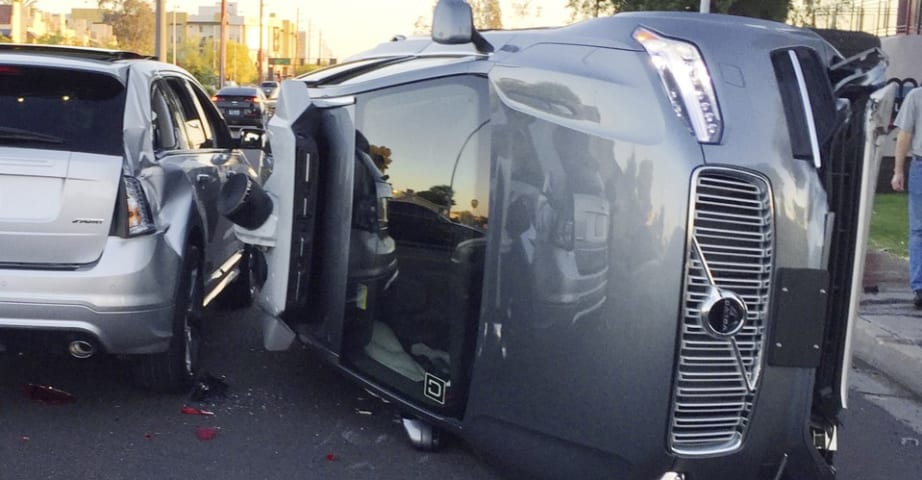
Advocates of autonomy tend to cite overall improvements to road safety in a future of self-driving cars. Ninety-four percent of car crashes are caused by driver error, and both fully and partially autonomous cars could improve that number substantially—particularly by reducing injury and death from speeding and drunk driving. Even so, crashes, injuries, and fatalities will hardly disappear when and if self-driving cars are ubiquitous. Robocars will crash into one another occasionally and, as the incident in Tempe illustrates, they will collide with pedestrians and bicyclists, too. Overall, eventually, those figures will likely number far fewer than the 37,461 people who were killed in car crashes in America in 2016.
The problem is, that result won’t be accomplished all at once, but in spurts as autonomous technology rolls out. During that period, which could last decades, the social and legal status of robocar safety will rub up against existing standards, practices, and sentiments. A fatality like the one in Tempe this week seems different because it is different. Instead of a vehicle operator failing to see and respond to a pedestrian in the road, a machine operating the vehicle failed to interpret the signals its sensors received and process them in a way that averted the collision. It’s useful to understand, and even to question the mechanical operation of these vehicles, but the Tempe fatality might show that their legal consequences are more significant than their technical ones.
Arizona Governor Doug Ducey has turned the state into a proving ground for autonomous cars. Ducey, a businessman who was the CEO of the franchised ice-cream shop Cold Stone Creamery before entering politics, signed an executive order in 2015 instructing state agencies to undertake “any necessary steps to support the testing and operation of self-driving cars on public roads within Arizona.” While safety gets a mention, the order cites economic development as its primary rationale. Since then, Uber, Waymo, Lyft, Intel, GM, and others have set up shop there, testing self-driving cars in real-world conditions—a necessity for eventually integrating them into cities.
The 2015 order outlines a pilot program, in which operators are required to “direct the vehicle’s movement if necessary.” On March 1, 2018, Ducey issued an updated order, which allowed fully autonomous operation on public roads without an operator, provided those vehicles meet a “minimal risk condition.” For the purposes of the order, that means that the vehicle must achieve a “reasonably safe state ... upon experiencing a failure” in the vehicle’s autonomous systems. The new order also requires fully autonomous vehicles to comply with registration and insurance requirements, and to meet any applicable federal laws. Furthermore, it requires the state Departments of Transportation and Public Safety, along with all other pertinent state agencies, to take steps to support fully autonomous vehicles. In this case, “fully autonomous” means a level four or five system by SAE standard, or one that a human need not operate at all, but which can be taken over by a human driver if needed.