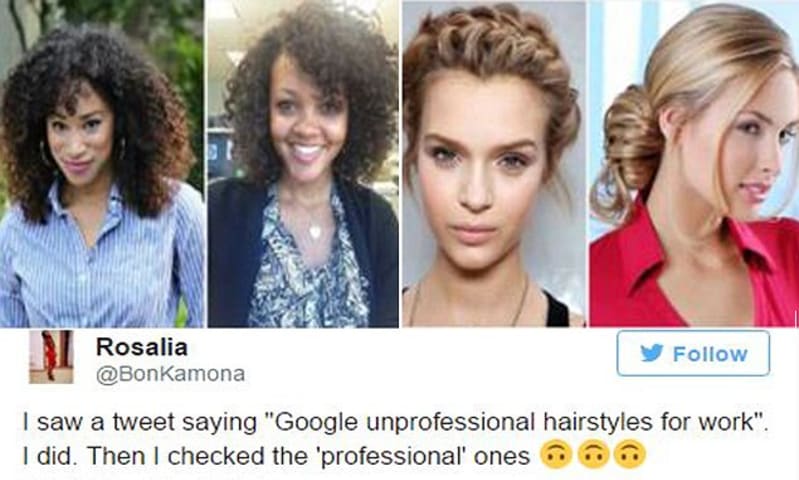
A woman was left shocked after googling the phrase 'unprofessional hairstyles at work' and seeing that the results were all pictures of black women.
Bonnie Kamona, from Botswana, posted on Twitter: 'I saw a tweet saying "Google unprofessional hairstyles for work". I did. Then I checked the "professional' ones",' which she discovered to her horror were all images of white women.
A screengrab of the masters student's discovery has since incited a flurry of messages on social media from users branding Google 'racist.'
@SaintWalker98 tweeted: 'Holy s***, that's racist AF.'
However, another user @KhaliRamah also posted that the results were not 'rocket science,' as it showed black people versus white people and he called it 'racist.'
Many people googled it for themselves to see the results with their own eyes.
Raj Palsingh posted: 'It is so bizarre I had to Google the same thing for myself' But he posted a screengrab showing the exact same findings.
@Jor93 tweeted: 'WTF that is ridiculous! They look amazing and totally normal. Better than any hairstyle I wear to work.'
While Ron Flexico tried the same search on another search engine to see if the results would differ.
He tried it out using Bing instead and found searching 'professional hairstyles' did come up with some black women as well, with one woman shown with her hair in a natural curled style.
While singer Brandy was included with her hair in a low-slung bun and a black model was seen with her hair in a top-knot style.
Some Twitter users explained why the results may show this, saying the results are a reflection of the amount of racist talk on the internet.
Derek Hopper tweeted: 'If forums are full of people saying "cornrows" or "dreads" are unprofessional, that's what Google will show.'
Raj Palsingh replied this explanation didn't hold up as 'none of the images showed cornrows or dreads. Just black women with nice natural hairstyles.'
Google told Metro.co.uk: ‘This is fundamentally a societal problem — there are persistent and problematic biases, and they’re quite pervasive in the media, on the web, etc – meta-tagging their images with their own descriptions.
‘Search engines in turn reflect what’s on the web. This is not unique to our search engine; Yahoo! and Bing show similar results.
‘We welcome feedback and we’re always working to improve our search results. As a company we strongly value a diversity of perspectives, ideas and cultures — these search results do not reflect Google’s view on the matter.’
MailOnline have approached Google for comment.