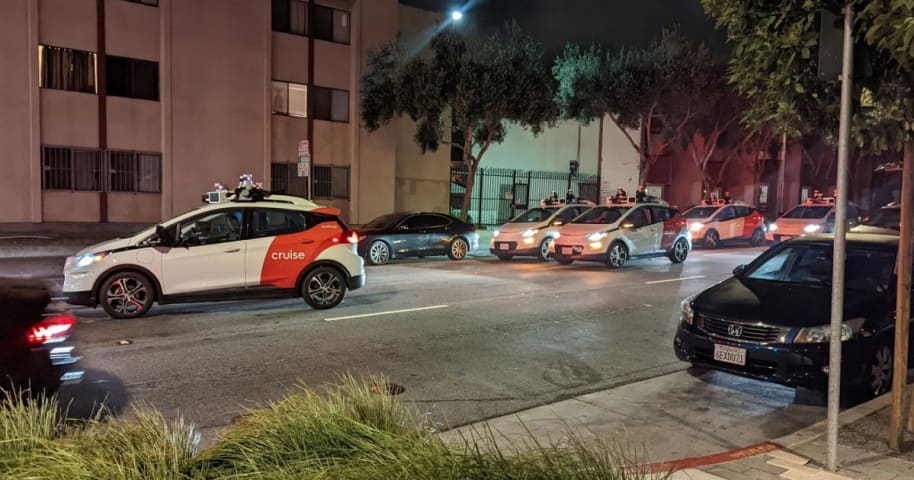
Cruise’s driverless cars experienced serious issues Tuesday night with as many as 20 of its vehicles standing motionless for about two hours at the corner of Gough and Fulton streets, according to an eyewitness. The incident was only resolved when the robo-cars were manually moved out of the way by Cruise staff.
Sean Sinha, the bouncer at Smuggler’s Cove bar on Gough Street, told the Examiner that around 10 p.m. Tuesday, “Cruise cars started to flood down Gough and make a right on Fulton, only to stop. Pretty soon over twenty cars were stopped, blocking traffic on Gough.”
At one point, two of Gough’s three southbound lanes lanes were impassable due to the motionless cars, as photos shared by Sinha on Reddit show.
After about 20 minutes, the first of several Cruise employees arrived and began manually moving the cars. The ordeal wasn’t resolved until after midnight, Sinha said.
In the meantime, between the Cruise driverless cars and the double-parked cars of arriving Cruise staff, some travel lanes on Gough and Fulton remained impassable. The motionless cars inhibited regular street sweeping, Sinha said.
That same night, at about 12:30 a.m. Wednesday, Twitter user @mannsiii wrote a now-deleted tweet saying that four Cruise driverless cars were idling near Fell and Masonic over multiple light cycles, blocking traffic and causing other cars to reverse off of the block in order to get around them.
In response to specific questions about both incidents, a Cruise spokesperson provided the following statement: "We had an issue earlier this week that caused some of our vehicles to cluster together. While it was resolved and no passengers were impacted, we apologize to anyone who was inconvenienced.”
The San Francisco Police Department said it did not receive any reports about these events.
The issues come less than a month after the California Public Utilities Commission approved Cruise to begin a late-night, paid ride-hailing service in San Francisco without a backup driver, allowing the robo-taxis to directly compete with Uber and Lyft. Already, Cruise and autonomous vehicle competitor Waymo are providing free rides, sans driver, to a select group of passengers around San Francisco. Both companies are also testing their vehicles around The City during daylight hours with backup safety drivers.
San Francisco transportation, police and fire officials urged the CPUC to reject Cruise’s permit for commercial ride hailing services, in part due to concerns about Cruise vehicles blocking traffic. City officials claimed in a letter to the CPUC that they do not believe Cruise vehicles are technologically capable of pulling over to the curb to pick up and drop off passengers, instead double-parking in the travel lane. Cruise denies this.
City officials also cited three specific incidents where Cruise vehicles behaved unsafely, including one where a Cruise vehicle idled in a construction zone for five minutes blocking traffic. In another instance, an idling Cruise vehicle blocked the passage of a fire truck responding to a blaze for about 30 seconds.
“SFFD is extremely concerned about vehicles stopping in travel lanes and the potential negative impact of this driving behavior on fire department response times,” the letter reads.
The City’s letter to the CPUC also revealed that a loophole in state law makes it impossible for law enforcement to cite driverless vehicles with moving violations, like running a red light or an illegal turn. Driverless vehicles can, however, be cited for parking violations, like blocking the travel lane.