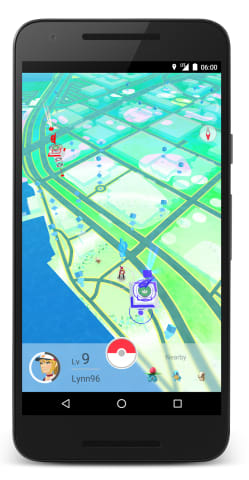
The game's popularity proliferated after a July 6 launch in Australia, New Zealand, and the United States: 7.5 million downloads during its first week; 50 million downloads from Google Play during its first month; and it was WikiPedia's most visited article by mid-July. Everyone noticed. Early in July, a former advertising coworker joked on Facebook:
" 'How about we partner with Pokemon Go?' -- Said in every office at every agency for every client this morning."
Probably. The augmented-reality (AR) mobile game requires players to travel real-life streets to find and capture digital characters superimposed on locations and displayed on the screens of players' phones. The game's screens also display PokeStops and gyms, locations superimposed on real-life landmarks. The CNN video at the end of this blog post provides a good summary. The Apple iTunes site explains important game details:
"Search far and wide for Pokémon and items: Certain Pokémon appear near their native environment—look for Water-type Pokémon by lakes and oceans. Visit PokéStops, found at interesting places like museums, art installations, historical markers, and monuments, to stock up on Poké Balls and helpful items... As you level up, you’ll be able to catch more-powerful Pokémon to complete your Pokédex. You can add to your collection by hatching Pokémon Eggs based on the distances you walk... Take on Gym battles and defend your Gym: As your Charmander evolves to Charmeleon and then Charizard, you can battle together to defeat a Gym and assign your Pokémon to defend it against all comers."
For many players, Pokemon Go has been a nostalgic return to their youth when Pokemon existed in cartoons, video games, and board-games. Some experts have speculated that the game's popularity, as measured by daily active users, may have peaked in the United States.
What do we know so far about the AR game? What has happened since the game's launch? What happens when a mobile fantasy game combines real-life locations? Are non-players affected? What might be the implications for future AR games? I looked for answers, found plenty, and organized my findings into good, bad, and ugly categories -- with apologies to Mr. Leone and Mr. Eastwood.
The Good
Niantic Labs developed the game for Apple iOS and Android devices. Earlier this month, the game debuted in Latin America. Reviewers have cited the game's addictive qualities:
"... Pokemon Go’s game designers have perfectly executed on the “Hook Model” — a framework for gamification and getting users to come back again and again and again."
Advocates have said that the game has gotten gamers off of their couches (e.g., butts) and out into the real world to get exercise, meet people, and explore locations they probably wouldn't have visited otherwise. Sounds good.
Within the game, PokeStops and gyms are located in publicly-accessible locations, such as theme parks, gardens, and museums. This has increased the sales at some nearby, small businesses. IGN reported on July 21:
"Bok Tower Gardens, a “contemplative garden” and National Historic Landmark located in Lake Wales, Fl, is saturated with PokeStops. The non-profit recorded a 10 to 15 percent increase in ticket sales during the first week of Pokemon Go’s release... So far, the only way to become a PokeStop or gym is to send in a request to Niantic Labs, but it isn't likely to be accepted unless the location is one of cultural significance or in a Pokemon Go deadzone."
The Twitter account Pokemon Archaeology catalogs Pokemon sightings in historic locations. The National Park Service (NPS) has welcomed gamers in many of its parks, but not at memorial sites. Some National Parks have featured programs with the game. Earlier this month, the Sleeping Bear Dunes National Lakeshore offered a new program called "Pokemon Hunt:"
"... to connect “Pokemon Go!” with real-world flora and fauna... This interactive, ranger-guided walk will allow visitors to uncover the creatures, both physical and virtual, that can be found within the National Lakeshore. They will learn how these creatures do or do not fit in with the rest of the environment, and what can be done to help them thrive. At the end of the program, visitors will be able to design their own Pokemon. “Trainers” of all ages are welcome."
This summer, the NPS celebrates 100 years of operations. Gamers should check the NPS site to learn about any discounts and programs before visiting a park.
Some local businesses near colleges and universities experienced increased sales from gamers. Minnesota Daily reported:
"Many local Minneapolis businesses have considered, or implemented, special promotions to attract more mobile-gamers. Last week, Sencha Tea Bar in Stadium Village released three special shakes in correspondence with the three color teams of the game — red, yellow and blue — said store manager Josh Suwaratana. Suwaratana said the store does special shakes for other occasions, so