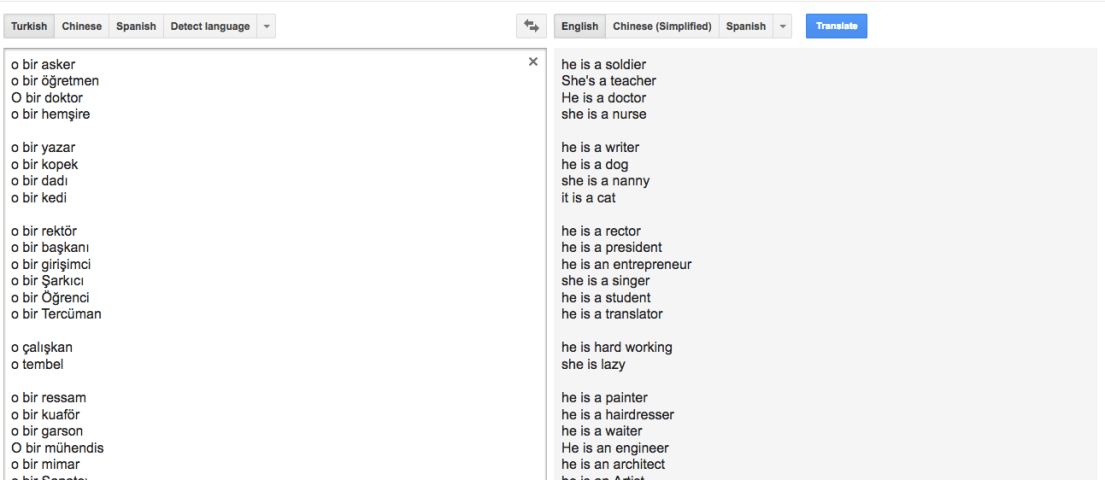
In the Turkish language, there is one pronoun, “o,” that covers every kind of singular third person. Whether it’s a he, a she, or an it, it’s an “o.” That’s not the case in English. So when Google Translate goes from Turkish to English, it just has to guess whether “o” means he, she, or it. And those translations reveal the algorithm’s gender bias.
Here is a poem written by Google Translate on the topic of gender. It is the result of translating Turkish sentences using the gender-neutral “o” to English (and inspired by this Facebook post).
Gender
by Google Translate
he is a soldier
she’s a teacher
he is a doctor
she is a nurse
he is a writer
he is a dog
she is a nanny
it is a cat
he is a president
he is an entrepreneur
she is a singer
he is a student
he is a translator
he is hard working
she is lazy
he is a painter
he is a hairdresser
he is a waiter
he is an engineer
he is an architect
he is an artist
he is a secretary
he is a dentist
he is a florist
he is an accountant
he is a baker
he is a lawyer
he is a belly dancer
he-she is a police
she is beautiful
he is very beautiful
it’s ugly
it is small
he is old
he is strong
he is weak
he is pessimistic
she is optimistic
It’s not just Turkish. In written Chinese, the pronoun 他 is used for “he,” but also when the person’s gender is unknown, like “they” has come to be used in English. But Google only translates into “she” when you use 她, the pronoun that specifically identifies the person as a woman. So in the case of a gender tie, Google always chooses “he.” In Finnish, the pronoun “hän,” meaning either “he” or “she,” is rendered as “he.”
In a way, this is not Google’s fault. The algorithm is basing its translations on a huge corpus of human language, so it is merely reflecting a bias that already exists. In Estonian, Google Translate converts “[he/she] is a doctor” to “she,” so perhaps there is less cultural bias in that corpus.
At the same time, automation can reinforce biases, by making them readily available and giving them an air of mathematical precision. And some of these examples might not be the most common that Turks look to translate into English, but regardless, the algorithm has to make a decision as to “he” or “she.”
At least she remains optimistic.