Just over a year after Michael Brown’s death became a focal point for a national debate about policing and race, Ferguson and nearby St. Louis suburbs have returned to what looks, from the outside, like a kind of normalcy. Near the Canfield Green apartments, where Brown was shot by police officer Darren Wilson, a sign reading “Hands Up Don’t Shoot” and a mountain of teddy bears have been cleared away. The McDonald’s on West Florissant Avenue, where protesters nursed rubber bullet wounds and escaped tear gas, is now just another McDonald’s.
Half a mile down the road in the city of Jennings, between the China King restaurant and a Cricket cell phone outlet, sits an empty room that the St. Louis County Police Department keeps as a substation. During the protests, it was a war room, where law enforcement leaders planned their responses to the chaos outside.
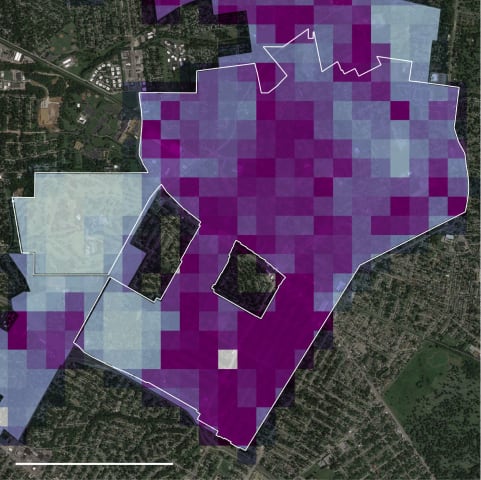
One day last December, a few Jennings police officers flicked on the substation’s fluorescent lights and gathered around a big table to eat sandwiches. The conversation drifted between the afternoon shift’s mundane roll of stops, searches, and arrests, and the day’s main excitement: the officers were trying out a new software program called HunchLab, which crunches vast amounts of data to help predict where crime will happen next.
The conversation also turned to the grand anxieties of post-Ferguson policing. “Nobody wants to be the next Darren Wilson,” Officer Trevor Voss told me. They didn’t personally know Wilson. Police jurisdiction in St. Louis is notoriously labyrinthine and includes dozens of small, local municipal agencies like the Ferguson Police Department, where Wilson worked — munis, the officers call them — and the St. Louis County Police Department, which patrols areas not covered by the munis and helps with “resource intense events,” like the protests in Ferguson. The munis have been the targets of severe criticism; in the aftermath 2014's protests, Ferguson police were accused by the federal Department of Justice of being racially discriminatory and poorly trained, more concerned with handing out tickets to fund municipal coffers than with public safety.
The officers in Jennings work for the St. Louis County Police Department; in 2014, their colleagues appeared on national TV, pointing sniper rifles at protesters from armored trucks. Since then, the agency has also been called out by the Justice Department for, among other things, its lack of engagement with the community.
ST. LOUIS COUNTY HUNCHLAB CRIME MAP ST CHARLES FLORISSANT FERGUSON JENNINGS Mississippi River CHESTERFIELD FLORISSANT St. Louis 70 ST CHARLES BALLWIN KIRKWOOD 270 FERGUSON FENTON JENNINGS MEHLVILLE Mississippi River MARYLAND HEIGHTS 64 St. Louis CHESTERFIELD 5 miles CREVE COEUR CLAYTON ST. LOUIS COUNTY POLICE DEPARTMENT JURISIDICTION BALLWIN WILDWOOD ST CHARLES KIRKWOOD FLORISSANT 55 FERGUSON JENNINGS FENTON Mississippi River CHESTERFIELD 255 St. Louis MEHLVILLE 44 BALLWIN KIRKWOOD FENTON MEHLVILLE 5 miles 5 miles ST. LOUIS COUNTY POLICE JURISIDICTION ST. LOUIS COUNTY ST CHARLES FLORISSANT FLORISSANT FERGUSON FERGUSON JENNINGS JENNINGS Mississippi River Mississippi River CHESTERFIELD CHESTERFIELD St. Louis St. Louis BALLWIN BALLWIN FENTON FENTON MEHLVILLE MEHLVILLE 5 miles 5 miles HUNCHLAB CRIME MAP ST CHARLES FLORISSANT 70 FERGUSON 270 JENNINGS 64 Mississippi River CHESTERFIELD St. Louis BALLWIN KIRKWOOD 55 255 FENTON MEHLVILLE 44 5 miles ST. LOUIS COUNTY ST CHARLES FLORISSANT 70 FERGUSON 270 JENNINGS 64 Mississippi River CHESTERFIELD St. Louis BALLWIN KIRKWOOD 55 255 FENTON MEHLVILLE 44 5 miles ST. LOUIS COUNTY POLICE JURISIDICTION ST CHARLES FLORISSANT FERGUSON JENNINGS Mississippi River CHESTERFIELD St. Louis BALLWIN KIRKWOOD FENTON MEHLVILLE 5 miles HUNCHLAB CRIME MAP ST CHARLES FLORISSANT FERGUSON JENNINGS Mississippi River CHESTERFIELD St. Louis BALLWIN KIRKWOOD FENTON MEHLVILLE 5 miles
Still, the county police enjoy a better local reputation than the munis. Over the last five years, Jennings precinct commander Jeff Fuesting has tried to improve relations between officers — nearly all white — and residents — nearly all black — by going door to door for “Walk and Talks.” Fuesting had expressed interest in predictive policing years before, so when the department heads brought in HunchLab, they asked his precinct to roll it out first. They believed that data could help their officers police better and more objectively. By identifying and aggressively patrolling “hot spots,” as determined by the software, the police wanted to deter crime before it ever happened.
HunchLab, produced by Philadelphia-based startup Azavea, represents the newest iteration of predictive policing, a method of analyzing crime data and identifying patterns that may repeat into the future. HunchLab primarily surveys past crimes, but also digs into doze